Latest / Story
Can I Reuse Another Team's Authorization Package for My Own System?
Another team already holds an authorization for a system like yours. You want to copy their package and save months of work. Some parts transfer. Some parts do not.
What reuse means in the RMF
RMF means Risk Management Framework. It is the process in NIST SP 800-37 Revision 2. That guide describes how a system earns an authorization to operate. ATO means Authorization to Operate. It is the formal decision that a system may run (NIST SP 800-37 Revision 2).
Reuse in the RMF is called reciprocity. Reciprocity means one authorizing official accepts the work of another. It does not mean the package moves as a whole. It means specific results can be trusted again.
The authorizing official decides. AO means authorizing official. The AO is the senior person who accepts risk for the system. No one else can grant that acceptance for your system.
What you can reuse
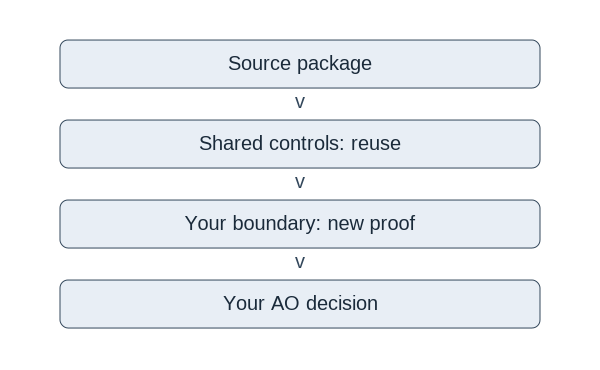
You can reuse control results for parts you truly share. If you run on the same cloud platform, you can cite its controls. If you use the same shared service, you can cite its assessment results. The key test is sameness. The part must be the same part, run the same way.
You can reuse the assessment method. The test steps, the evidence format, and the interview questions can carry over. You can reuse the structure of the package. The system description format and the plan layout can carry over too.
You can also reuse findings about common controls. A control run by a central team for many systems is a common control. Its result applies to each system that uses it. Your package should name the provider of that control.
What you must still prove yourself
Your system boundary is your own. A boundary is the line around what you own and run. Another team's boundary does not cover your data flows. Draw your own boundary diagram. List your own connections and data types.
Your risks are your own. Your data, your users, and your mission differ from theirs. The AO for your system must see your risk picture. A copied risk section hides your real risks.
Your implementation details are your own. How you set a control may differ from how they set it. If you claim their result, you must show your setting matches theirs. If it does not match, you need your own test result.
Your POA&M is your own. POA&M means Plan of Action and Milestones. It lists your open gaps and your fix dates. You cannot inherit another team's open items. You also cannot inherit their closure dates.
How to ask for reuse
Start with a short reuse memo. Name the source system and its authorization date. List each control result you want to reuse. For each one, state why it applies to your system.
Attach the source evidence, not just a claim. The AO needs to see the test result. A one line claim that "they passed" will not hold up.
Meet the AO early. Ask which results they will accept before you write the full package. An early no saves weeks of writing. An early yes shapes the whole package.
Then write your package around the gaps. Spend your pages on what is new, changed, or different. That is where the AO will focus anyway.
The mistake to avoid
Do not file a copied package with new names on it. Assessors spot copied text fast. Copied text also creates false claims. If a copied sentence describes a control you do not run, your package is wrong on its face.
Reuse is a shortcut for shared parts only. Your own parts still need your own proof.
Next step
PolicyCortex collects evidence from live Azure configuration using 33 collectors. The collectors read conditional access, diagnostic settings, Defender posture, backup, and firewall. The evidence is evaluated against NIST 800-53 and NIST 800-171. It supports re-verification after remediation. It generates SSP, SAR, and POA&M output from collected evidence. SAR means Security Assessment Report. PolicyCortex is strongest in commercial Azure, and AWS is covered. Start at https://policycortex.com.
Sources
- NIST SP 800-37 Revision 2, Risk Management Framework for Information Systems and Organizations, National Institute of Standards and Technology. https://doi.org/10.6028/NIST.SP.800-37r2