Latest / Story
Cold Chain Controllers and the ATO Boundary
Five government partners issued a joint warning on November 5, 2026. The Cybersecurity and Infrastructure Security Agency (CISA) led it. The Federal Bureau of Investigation (FBI) joined it. The Department of Health and Human Services (HHS) signed it too. The Department of Agriculture (USDA) and the Department of Transportation (DoT) signed it as well. The Internet Crime Complaint Center (IC3) published the advisory.
Attackers target electronic temperature controllers. They target commercial refrigeration controllers in grocery and cold storage sites. These are operational technology (OT) devices. They change real temperatures. A wrong setpoint spoils food and can create a fire hazard. Staff can lose sight of true temperatures.
The advisory names the ways in. Authentication bypass is one. Arbitrary code injection is another. Weak configurations are the third. The advisory names no vendor. It gives no victim counts. It attributes the activity to no group and no country. The warning is about exposure, not about one product.
Reporting shows what exposure can do. Reuters, via TechCrunch and BleepingComputer, reported an October 12 wave that hit an estimated 250 to 350 French supermarkets. Attackers remotely activated defrost and raised temperatures. A second wave in early November affected more than 115 stores across six European countries. On November 3, the French Blood Establishment confirmed an incident affecting refrigeration at three facilities storing blood products. These details come from reporting, not from the advisory.
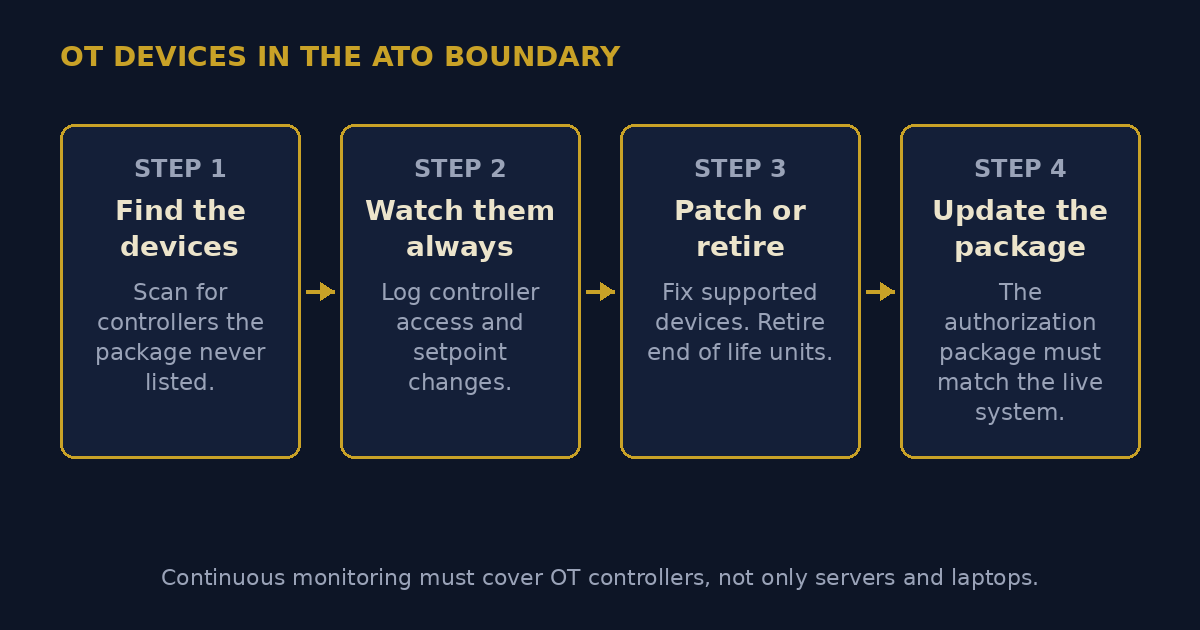
For an authorization to operate (ATO), the lesson is the boundary. An OT controller on the network is part of the system. If the authorization package never lists it, the package describes a system that does not exist. Continuous monitoring must cover it too. Log controller access. Log setpoint changes. Watch for a change no one approved. A device no one watches is a device no one can defend.
The advisory lists the fixes. Eliminate public internet exposure. Isolate OT devices on a dedicated virtual local area network (VLAN). Change default passwords. Enforce strong password policies. Use phishing resistant multi-factor authentication (MFA) where feasible. Apply patches. Retire end of life devices. Allowlist only the Internet Protocol (IP) addresses and devices that need access. Keep current offsite and offline backups. Review setpoint ranges.
Update the package when the fix lands. Record the new inventory entry. Record the new network segment. Record the patch date and the firmware version. A package that matches the live system is the point of the ATO. PolicyCortex does not patch controllers. PolicyCortex helps teams link proof to requirements.
Sources
- CISA, FBI, HHS, USDA, DoT, "US Government Partners Urge Hardening Industrial Refrigeration and Cold Chain Monitoring Systems," IC3 joint Cybersecurity Advisory, November 5, 2026, https://www.ic3.gov/CSA/2026/261105.pdf
- Reuters via TechCrunch and BleepingComputer, reporting on the October and early November waves and the French Blood Establishment incident.
- Original diagram by PolicyCortex.
Next step
Find every refrigeration controller your authorization package never listed, and add it with its firmware version and network segment.