Latest / Story
cPGuard Update Channel Compromise: ATO Continuous Monitoring Test
An authorization to operate rests on current proof. A trusted update channel can break that proof in one night.
What OPSSHIELD reported
On 2 November 2026 at 02:06 UTC, an attacker used compromised credentials. The attacker reached OPSSHIELD update distribution infrastructure. That infrastructure is a content delivery network (CDN). The attacker sent a malicious script through the cPGuard update channel. Affected updates were cPGuard 5.88.12 through 5.88.19 inclusive. OPSSHIELD detected the compromise within 12 hours. How the attacker obtained the credentials remains under investigation.
Why the boundary question matters
An authorization boundary lists the system and its parts. Servers sit inside that boundary. Their update channels sit inside it too. A monitoring plan that lists servers but not their update source has a gap. The script collected password files, database settings, and shell history. It also collected Secure Shell (SSH) authorization and known hosts files. A boundary record must show where each server got its updates. It must show which version each server ran on each date.
What monitoring must now show
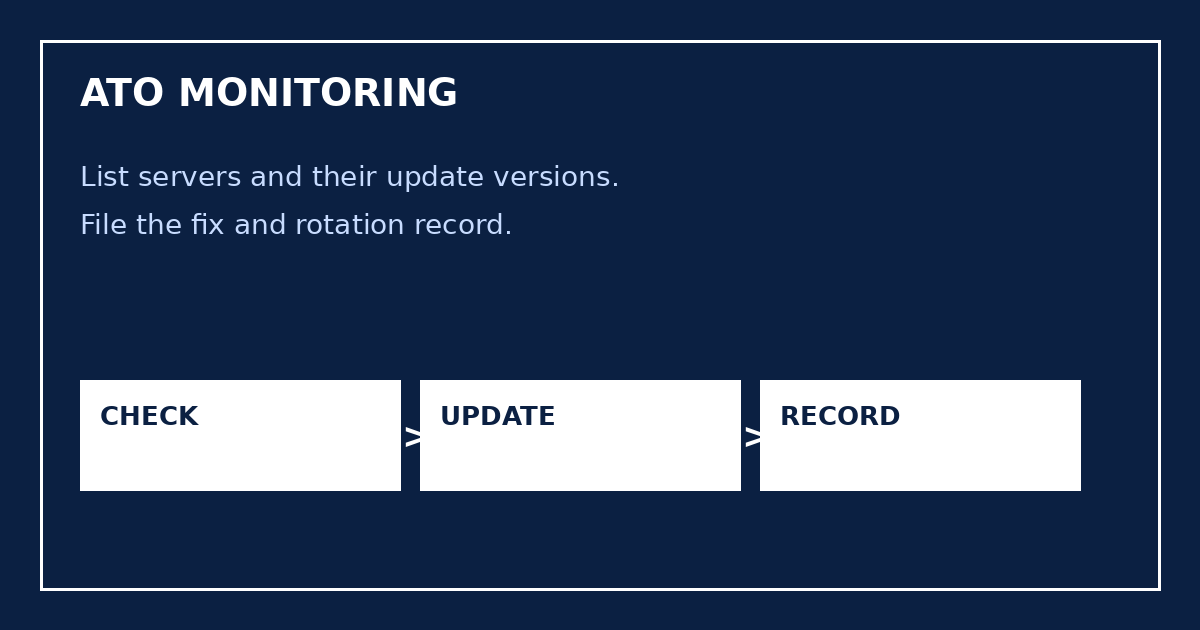
First, a list of every server that runs cPGuard. Second, the installed version on each server, by date. Third, a check for versions 5.88.12 through 5.88.19. Fourth, a check for the listed script, backdoor, and archive files. Fifth, proof each server moved to version 5.88.25 or later. Sixth, a record of every password, key, and token rotation. OPSSHIELD estimates 32 collected files were retrieved. Each file corresponded to one customer server. That figure is preliminary, not a total count of affected servers. Your file needs your own count, not the global estimate.
What to do this week
Run the cpgcli update command with the start option. Confirm the cpgcli version reads 5.88.25 or later. Reset root passwords from a trusted recovery environment. Rotate database passwords, cloud storage keys, and tokens. Replace private keys in /root/.ssh and remove old public keys. OPSSHIELD does not routinely recommend a full rebuild at this stage. That position is provisional, so watch for a later advisory update.
PolicyCortex does not clean compromised servers. PolicyCortex helps teams link proof to requirements.
Sources
- OPSSHIELD advisory, cPGuard update channel compromise. https://opsshield.com/notice/cpguard-update-channel-compromise.html
- Cybersecurity News coverage, November 3, 2026. https://cybersecuritynews.com/cpguard-supply-chain-attack/
- SecurityOnline coverage, November 3, 2026. https://securityonline.info/cpguard-supply-chain-attack/
- Original diagram by PolicyCortex
Next step
Add the update channel and the installed version to the monitoring inventory.