Latest / Story
Cursor Tampered Update Tests Continuous Monitoring for Developer Tools
The authorization boundary is the line around the system. Developer workstations often sit inside that line. Their tools sit inside it too. An update channel is part of the boundary as well. On October 29, 2026, a tampered update crossed that boundary through a trusted path. The update used the name Anthropic.claude-code. It appeared in the Cursor Visual Studio Code (VS Code) Extension Marketplace. Versions 2.1.312 and 2.1.313 for Windows and macOS were affected. The window ran from about 2:27am to 1:35pm Pacific Time.
What slipped through
The code added an attacker Secure Shell (SSH) key to authorized_keys. The key carried the label svc-telemetry. It set up persistence through a macOS LaunchAgent or a Windows scheduled task. It sent host details to an attacker server. On most hosts the reverse tunnel step failed without admin rights. The key, the persistence, and the host report still happened. A yearly check would miss an 11 hour exposure window. A point in time review would miss it too. Only ongoing monitoring catches a change that lives for hours.
What continuous monitoring must catch
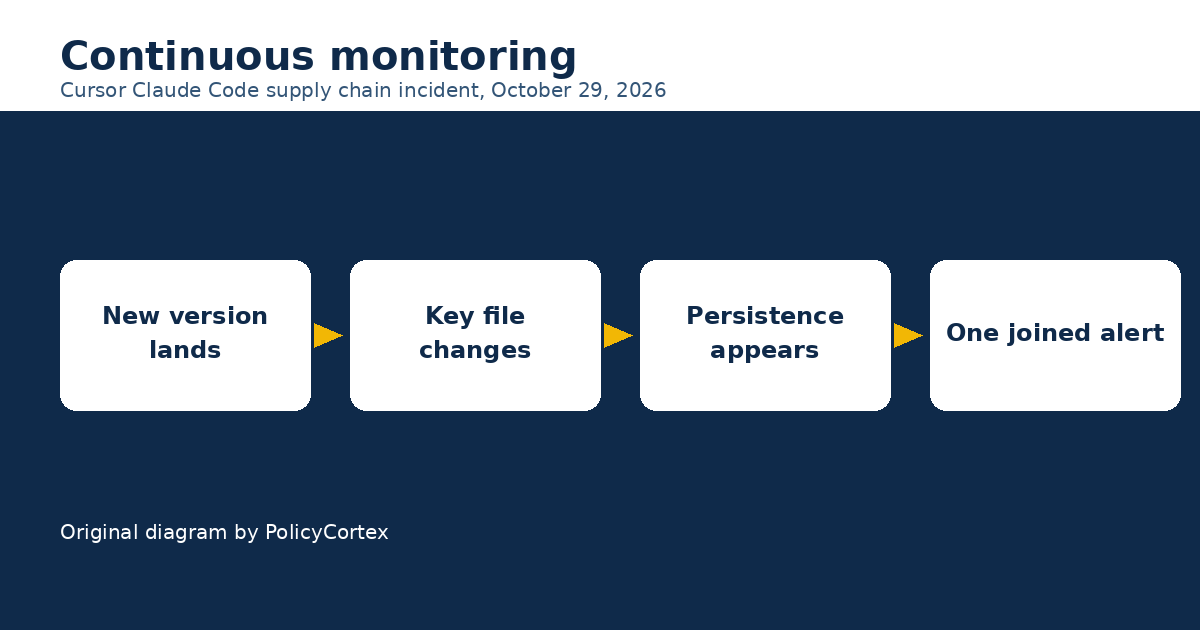
First, a new extension version on any in scope host. Second, a change to authorized_keys on any in scope host. Third, a new LaunchAgent or scheduled task the team did not approve. Fourth, a new outbound connection to an unknown host. Fifth, a new process that retries on a fixed interval. Each of these is a small event on its own. Together they form the shape of this attack. Monitoring must join them into one alert. A single log line about an update is not enough.
How to treat the boundary after this incident
Name developer tools in the boundary description. Name the update channel for each tool. State who may approve a new version. State how fast a tampered version must be flagged. Record the check that cleared each host after the incident. Keep the key check, the persistence check, and the rotation record together. An authorization file that omits developer tools leaves a live path out.
PolicyCortex does not monitor developer hosts. PolicyCortex helps teams link proof to requirements.
Sources
- Cursor security notice, updated October 30, 2026. https://cursor.com/blog/claude-code-extension-security-notice
- The Hacker News article, October 2026. https://thehackernews.com/2026/10/official-claude-code-vs-code-extension.html
- OpenSourceMalware research findings, as quoted by The Hacker News.
- Original diagram by PolicyCortex.
Next step
Add developer tools and their update channels to your boundary description.