Latest / Story
How Do I Handle a Control That Fails During the Security Assessment?
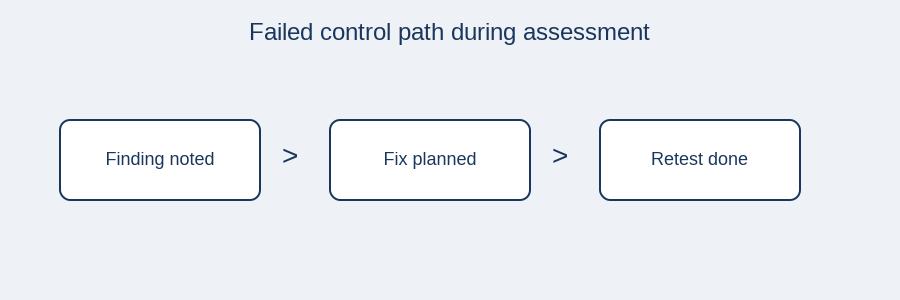
A failed control feels like a failed assessment. It is not. It is a finding with a fix path.
The Risk Management Framework (RMF) expects findings. The assessment step exists to find gaps before authorization. Your job is to handle each gap in the open.
Step one: get the finding in writing
Ask the assessor to state the exact control. Ask which assessment objective failed. Ask what evidence fell short.
Write the finding down the same day. Record the system part it affects. Record the evidence the assessor reviewed. Vague findings grow harder to close later.
Do not argue the finding on the spot. Ask clarifying questions instead. You can dispute a finding later with better evidence. A calm record helps that case.
Step two: fix it or plan the fix
Some failures have a fast fix. A missing log setting can be turned on. A stale procedure can be updated and signed. Fix those at once and show new evidence.
Other failures need more time. A missing tool or a design change takes weeks. For those, write a Plan of Action and Milestones (POA&M). A POA&M lists the fix, the owner, and the due date.
Be honest about the due date. A date you miss hurts more than a later date you meet. Add interim steps the assessor can check.
Step three: show the risk picture
The Authorizing Official (AO) decides on risk, not perfection. The AO is the senior official who grants authorization. Give the AO a clear risk note for each open finding.
The note should state what could go wrong. It should state who or what is exposed. It should state the interim control that lowers the risk.
If no interim control exists, say so plainly. Then state how you limit use until the fix lands. Limiting use is a real risk choice.
Step four: retest and close the loop
Ask the assessor how retesting will work. Some fixes need a fresh test of the control. Others need only a review of new records.
Save the retest evidence with the original finding. Keep the full chain in one place. The AO should see the failure, the fix, and the proof.
Update your authorization package as fixes close. A package that still lists closed findings as open confuses the decision. A clean package speeds the decision.
What the AO can still decide
An AO can grant authorization with open findings. The decision letter lists conditions for those findings. The letter also sets dates for closure checks.
An AO can also delay the decision until a key fix lands. That delay is not a denial. It is a pause tied to one risk.
A denial closes the current package. You then fix the findings and submit again. Knowing this range keeps one failure in scale.
What to do this week
List your open findings in one tracker. Give each one an owner and a due date. Check that each one has a risk note.
Sources
- NIST SP 800-37 Revision 2, Risk Management Framework, National Institute of Standards and Technology.
- NIST SP 800-53A Revision 5, Assessing Security and Privacy Controls, National Institute of Standards and Technology.
- Original diagram by PolicyCortex.
Next step
Want assessment findings tracked to closure in one place? See how PolicyCortex collects evidence from live systems.