Latest / Story
How Do I Prepare Evidence for the Assessor's Test Step, Not Just the Examine Step?
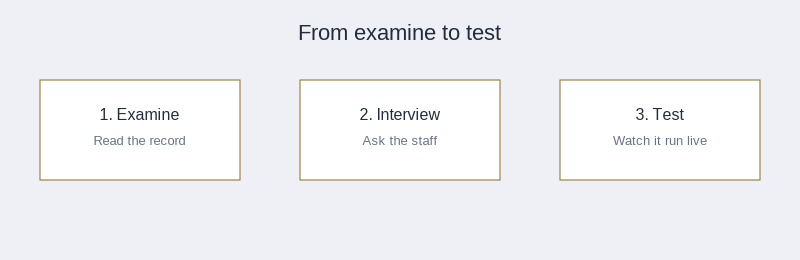
Your package has clean records, but the assessor still wants to see controls run live. That test step catches teams that only filed paper. The fix is to prepare live proof before the assessor arrives.
The Risk Management Framework (RMF) is the process agencies use to authorize systems. NIST Special Publication 800-37 Revision 2 describes that process. The assessment step checks each control in three ways: examine, interview, and test.
Examine means the assessor reads a record. Interview means the assessor asks staff how the work is done. Test means the assessor watches the control run, or checks its output directly. A record alone does not pass a test step.
Pick the controls that need live proof
Not every control needs a live demo. Start with controls that act on live systems. Access control is one. Audit logging is another. Flaw fixing is a third. Backup and recovery is a fourth.
For each control, write down the test the assessor will likely run. For access control, the test may be a login attempt with a wrong role. For audit logging, it may be a search for a past event. For flaw fixing, it may be a check of a patched system. For backup, it may be a restore of one file.
Build a test kit for each control
A test kit has four parts. First, a test account the assessor can use. Second, safe test data that harms nothing. Third, the steps to run the test. Fourth, the expected result in plain words.
Set up the test account before assessment week. Give it only the rights the test needs. Confirm it still works the day before the test. A dead test account wastes the whole session.
Write the steps as a short numbered list. Keep each step to one action. Name the person who will run each step. If a step needs a tool, name the tool and where it lives.
Record the test as you run it
During the test, save the output at once. Save the screen result, the log entry, or the report. Add the date, the tester name, and the system name. File that output with the other evidence for the control.
If a test fails, do not hide it. Note the failure, the cause, and the fix. Then run the test again and file the passing result beside the first one. Assessors trust a file that shows a fix more than a file that shows no test at all.
Brief the staff who will answer questions. They should describe the real process, not the ideal one. Their words must match the test steps and the records. A mismatch between words and records is a finding in itself.
What to do this week
List the controls in your package that need live proof. Build one test kit per control. Run each test once yourself. Fix any kit that fails before the assessor sees it.
Sources
- NIST SP 800-37 Revision 2, National Institute of Standards and Technology.
- NIST SP 800-53A Revision 5, National Institute of Standards and Technology.
- Original diagram by PolicyCortex.
Next step
Want assessment evidence tied to each control? See how PolicyCortex collects it from live systems.