Latest / Story
How Do I Prepare for the Security Assessment Interview?
Your documents look ready, but your staff have never answered an assessor out loud.
ATO means Authorization to Operate. RMF means Risk Management Framework. NIST means National Institute of Standards and Technology. AO means authorizing official. The AO is the senior leader who decides if a system may operate.
Know what the interview tests
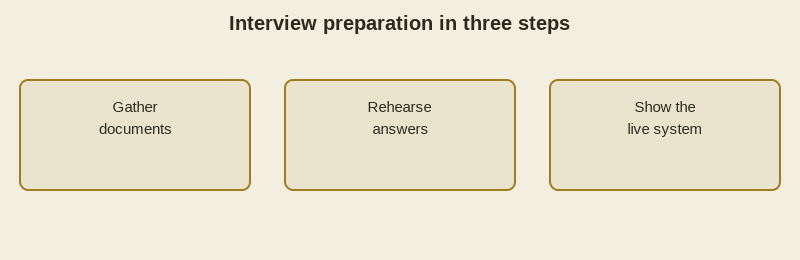
Assessors use three methods in every assessment. Examine means reading your documents. Interview means asking your staff. Test means checking the live system. These methods come from NIST SP 800-53A Revision 5.
An interview checks one thing. Do your people act the way your documents say they act? A polished document cannot save a confused answer. A clear answer cannot save a missing document.
The assessor will interview more than security staff. Expect administrators, managers, and regular users. Each person must describe only their own part. No one needs to know the whole package.
Build the interview list first
Start with your own staff list. Match each control to the person who runs it. Match each procedure to the person who follows it. That list becomes your interview list.
Check the list for gaps. A control with no named person is a gap. A procedure with no owner is a gap. Fix the owner before you rehearse anything else.
Tell each person early that they may be interviewed. Give them the control list for their role. Give them the procedure they must describe. Do not give them the whole package to memorize.
Rehearse in short sessions
Run one short session per role. Fifteen minutes is enough for most roles. Ask the questions an assessor would ask. Listen for vague answers. Vague answers point to weak procedures.
Use these five questions in every session. How do you do this task each day? Where is the record of that task? Who checks your work? What do you do when it fails? When did you last do it?
If the answer differs from the procedure, fix the procedure or fix the practice. Do not coach staff to repeat a false answer. The assessor will test the live system next. A false answer fails twice.
Tie every answer to a record
An answer without a record is only a claim. Teach staff to name the record as they answer. A log file, a ticket, a review sheet, or a dated export all count.
Practice this pattern. State what you do. Name the tool you use. Name the record it creates. State how often you do it.
Example answers stay short. I review access each month. I use the access review sheet. I file it in the evidence folder. The owner signs it after review.
Prepare for hard questions
Assessors ask about failures, not just success. They ask what happens when a control breaks. They ask who gets called. They ask how long a fix takes.
Prepare honest answers for three cases. A missed review, a failed backup, and a lost token. Each answer needs a name, a step, and a record. If you have no step, write one now.
Do not guess in the interview. A good answer is short and honest. I do not know that part. The owner for that part is named here. That answer beats a long guess every time.
Check the live system last
After rehearsals, check the live system. Match each rehearsed answer to a live setting. If the setting changed, update the document and the answer together. Do this in the week before the assessment.
The assessment plan sets the scope for this work. NIST SP 800-37 Revision 2 places assessment planning in the Assess step of the RMF. The plan names the methods, the scope, and the team. Your interview list should match that plan.
Next step
PolicyCortex collects evidence from live Azure configuration with 33 collectors. The collectors read conditional access, diagnostic settings, Defender posture, backup, and firewall. The evidence is evaluated against NIST 800-53 and NIST 800-171. That evidence supports re-verification after remediation. SAR means Security Assessment Report. POA&M means Plan of Action and Milestones. It generates SSP, SAR, and POA&M output from collected evidence. SSP means System Security Plan. AWS means Amazon Web Services. PolicyCortex is strongest in commercial Azure, and AWS is covered. Start at policycortex.com.
Sources
- NIST SP 800-37 Revision 2, Risk Management Framework for Information Systems and Organizations. https://csrc.nist.gov/pubs/sp/800/37/r2/final
- NIST SP 800-53A Revision 5, Assessing Security and Privacy Controls in Information Systems and Organizations. https://csrc.nist.gov/pubs/sp/800/53/r5/upd1/final
- NIST SP 800-53 Revision 5, Security and Privacy Controls for Information Systems and Organizations. https://csrc.nist.gov/pubs/sp/800/53/r5/upd1/final
- Diagram: original by blog.atoevidence.com.