Latest / Story
How Do I Write an Executive Summary an AO Will Actually Read?
Your authorizing official will read the summary before the full package. That reader is busy, and the package is long. The summary must carry the decision on its own.
The authorizing official (AO) is the senior official who accepts or denies risk for a system. RMF means Risk Management Framework. NIST SP 800-37 Revision 2 describes the RMF. In the Authorize step, the AO reviews the package and decides if risk is acceptable. The executive summary gives the AO the consolidated view of that package. It highlights risk issues and the facts needed for a sound decision.
What the summary must contain
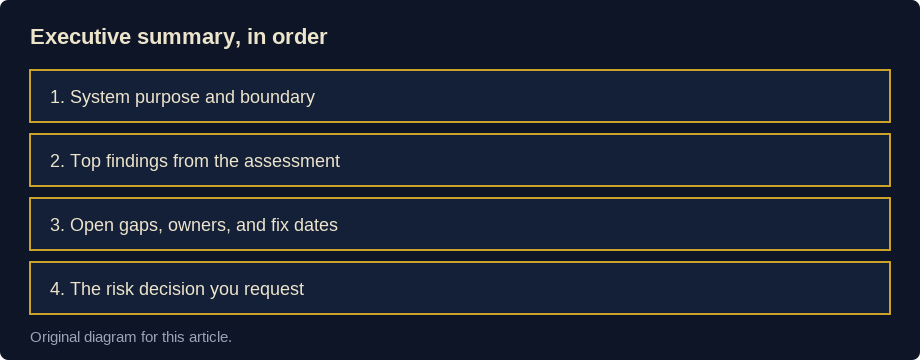
Start with the system in one short paragraph. State what the system does and who uses it. State the authorization boundary in plain words. The boundary is the list of parts in scope and the parts out of scope. If the AO cannot tell what is being authorized, nothing else in the summary will land.
Next, give the assessment result in plain words. State how many findings were open at the end of testing. State the worst findings first, not last. For each major finding, state the risk in one sentence. State the fix and its date in the next sentence. Do not hide the worst finding at the back. An AO who finds a surprise late will doubt the rest of the package.
Then list every open gap with its owner and due date. A gap with no owner and no date is not a plan. It is a hope. Link each gap to your POA&M. POA&M means Plan of Action and Milestones. The AO should be able to trace each gap from the summary to the POA&M without guessing.
Close with the decision you request. State it in one sentence. Ask for authorization to operate, authorization with conditions, or a denial with a path back. If you ask for conditions, name them. The AO should not have to draft your request for you.
What to leave out
Leave out control by control detail. That detail belongs in the assessment report and the security plan. Leave out raw scan output and long tables. Leave out background history that does not change the risk picture. Every paragraph should answer one question the AO will ask. If a paragraph answers no question, cut it.
Keep numbers consistent with the full package. If the summary says three open findings, the report must say three open findings. A mismatch here breaks trust in every other number. Check each number against its source before you submit.
A drafting order that works
Write the summary last, after the assessment report is final. Draft the four parts in order: purpose, findings, gaps, decision. Then read it cold, as if you knew nothing about the system. Mark every sentence that needs the full package to make sense. Rewrite those sentences until each one stands alone.
Ask one colleague to read it in five minutes and tell you the decision. If that colleague cannot state the decision, the summary is not ready. If that colleague can, but names the wrong risk as the top risk, reorder the findings. The first finding a reader meets should be the largest risk, not the first control tested.
The test before you submit
Read the summary once more with the AO in mind. Does it state what is at risk? Does it state what is still open? Does it state when each open item closes? Does it state the decision you want? If any answer is no, fix that part now. A short summary that answers those four questions beats a long one that answers none of them well.
Next step
PolicyCortex collects evidence from live Azure configuration using 33 collectors. The collectors read conditional access, diagnostic settings, Defender posture, backup, and firewall. The evidence is evaluated against NIST 800-53 and NIST 800-171. It supports re-verification after remediation. It generates SSP, SAR, and POA&M output from collected evidence. SAR means Security Assessment Report. SSP means System Security Plan. PolicyCortex is strongest in commercial Azure, and AWS is covered. Start at https://policycortex.com.
Sources
- NIST SP 800-37 Revision 2, Risk Management Framework for Information Systems and Organizations: A System Life Cycle Approach for Security and Privacy, National Institute of Standards and Technology. https://doi.org/10.6028/NIST.SP.800-37r2
- NIST SP 800-53 Revision 5, Security and Privacy Controls for Information Systems and Organizations, National Institute of Standards and Technology. https://doi.org/10.6028/NIST.SP.800-53r5