Latest / Story
Linux Kernel TCP Flaw Belongs in ATO Monitoring
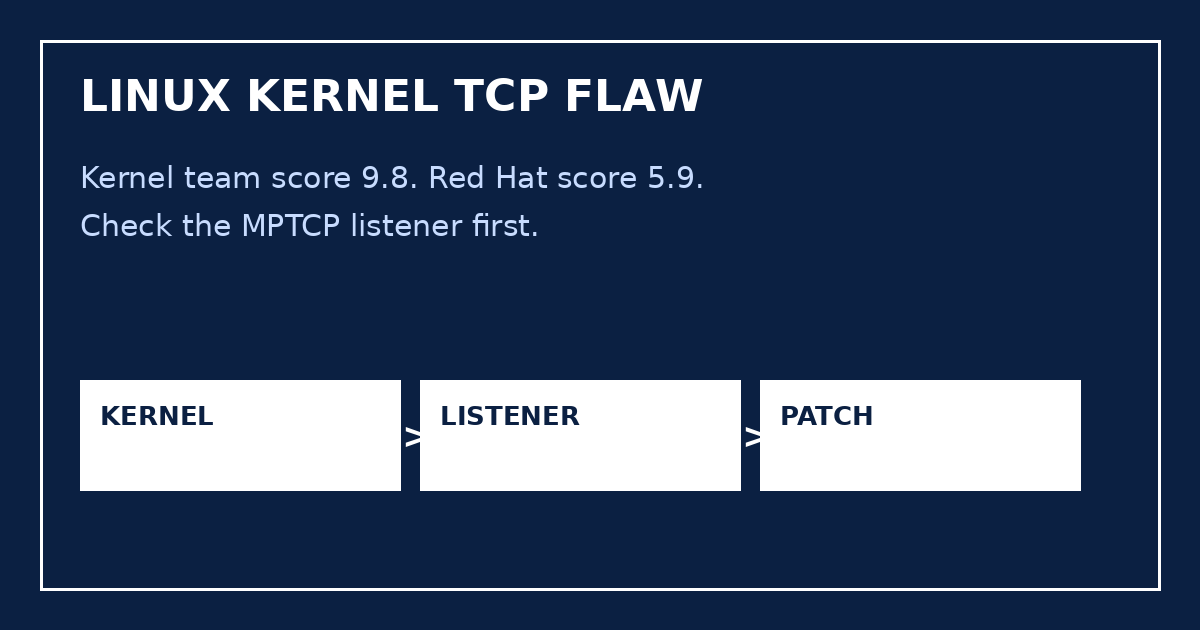
An Authorization to Operate (ATO) rests on monitoring after approval. A new kernel flaw is new monitoring evidence. It must reach the record fast, with its dispute noted.
The record is CVE-2026-98432. Common Vulnerabilities and Exposures (CVE) is the record system. It is a use-after-free flaw in Linux kernel network code. The kernel team scored it 9.8 under Common Vulnerability Scoring System (CVSS) version 3.1. Red Hat rates it 5.9. The race is hard to win, per Red Hat.
Why the listener check matters
The public exploit ran on a server with a Multipath TCP (MPTCP) listener. MPTCP is Multipath TCP, a way to spread one connection over paths. Remote code execution is not publicly proven without such a listener. Your monitoring record must state the listener result per host.
Go 1.24 turns MPTCP on by default for Transmission Control Protocol (TCP) listeners on Linux. Some Go services may enable it without knowing. Check listeners, not only settings you chose.
What monitoring must capture
Your record needs the kernel version before the patch. It needs the fixed version after the patch. Upstream fixed versions include 6.1.190 and 6.12.113. Debian fixed Bookworm with 6.1.190-1. Debian fixed Trixie with 6.12.113-1.
Ubuntu and Red Hat Enterprise Linux fixes were still planned or in progress on October 30, 2026. A host on those systems stays open until its distributor ships. Record that wait as an open item, not as done.
No confirmed exploitation in the wild is reported. The flaw is not in the Known Exploited Vulnerabilities (KEV) Catalog. The Cybersecurity and Infrastructure Security Agency (CISA) maintains that catalog. That fact lowers urgency, but it does not remove the patch duty.
CIQ published nftables guidance for this flaw. It blocks Internet Protocol version 4 (IPv4) TCP packets with IP options before vulnerable code runs. Disabling MPTCP alone is not enough. Record any mitigation beside the patch plan.
PolicyCortex does not patch Linux kernels. Vendors and distributors ship those fixes. PolicyCortex helps teams collect the monitoring record.
What to do this week
List every Linux host and its kernel version. Check each host for an MPTCP listener. Patch where a distributor fix exists. Track the rest as open items.
Sources
- CVE-2026-98432 record, CVE Program
- CVE-2026-98432 detail, National Vulnerability Database
- Anthropic Frontier Red Team exploit test, reported October 2026
- Red Hat rating of 5.9, reported October 2026
- CIQ nftables mitigation guidance, October 2026
- Original diagram by PolicyCortex
Next step
Want monitoring evidence that refreshes itself from the live system? See how PolicyCortex collects it on Azure.