Latest / Story
PwnEscape Belongs in ATO Continuous Monitoring Evidence
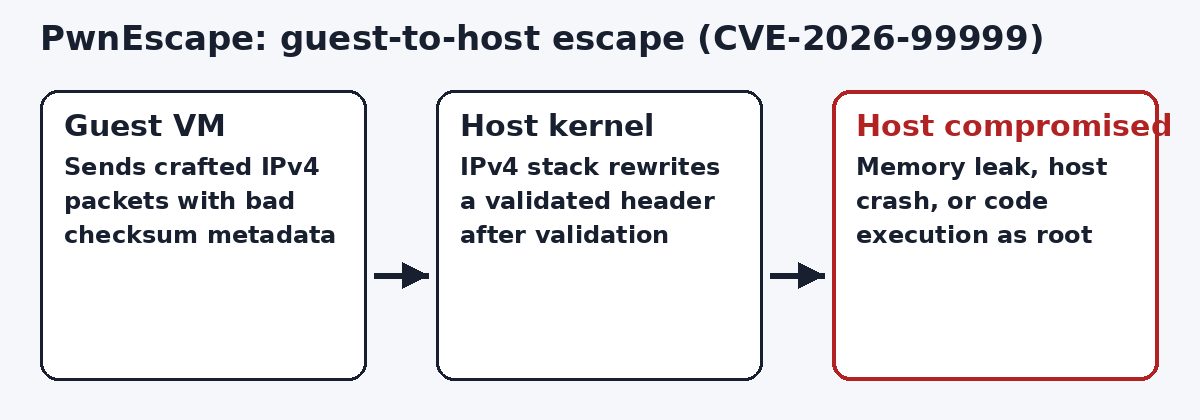
An authorization to operate is a promise that monitoring continues after approval. PwnEscape tests what that monitoring actually covers.
CVE-2026-99999 is a flaw in the Linux kernel's IPv4 stack. A guest virtual machine (VM) can send crafted packets that make the host kernel rewrite a validated header. The result crosses the isolation boundary: host memory leaks, host crashes, and code execution as root on the host. The Linux kernel security team rates it 9.3, Critical.
The flaw is not in the hypervisor. It is in the host kernel that every VM talks to. Patching the guests does not fix it. Only a host kernel update does.
What continuous monitoring actually means
ATO is Authorization to Operate. It is the formal decision that a system may run. Continuous monitoring is the work that keeps that decision honest.
NIST SP 800-53 control SI-2 asks agencies to fix flaws and install updates promptly. Control SI-4 asks them to monitor for attacks and indicators. For a virtualized system, those controls cover the hypervisor and host kernel too.
PwnEscape was reported privately on September 4, 2026. The fix entered the mainline kernel in October. A monitoring process that only scans guest images would have missed it completely.
Why the host layer fits the package
The authorization package records the system's security posture. That posture includes the layer that enforces isolation.
For PwnEscape, the monitoring event record is simple. List the host kernels in the boundary. Record the current version against the fixed versions: 5.10.272, 5.15.223, 6.1.190, 6.6.159, 6.12.113, 6.18.57, and 7.2.11. Record the patch date and the verification after.
If no authorized system runs Linux virtualization hosts, the record says so. An explicit no is evidence too.
The boundary lesson
Many packages draw the boundary around workloads and treat the virtualization layer as inherited. That inheritance claim needs its own evidence. If the cloud provider owns the hosts, the package should show the provider's patch evidence. If you own the hosts, the patch evidence is yours to produce.
PwnEscape lived in the kernel for years before anyone found it. The question for your package is not whether you could have known. It is whether your monitoring covers the layer today.
What to do this week
Inventory host kernels on every system in the authorization boundary. Compare them against the fixed versions. Patch the hosts, then verify.
Add host kernel versions to the monitoring checklist if they are not there. The next flaw in this layer should be a routine event, not a surprise.
Sources
- CVE-2026-99999 record, CVE Program. Published October 15, 2026, updated October 19, 2026. CVSS 3.1 base score 9.3, Critical.
- PwnEscape technical writeup, pwn.ai. https://pwn.ai/blog/pwnescape
- NIST SP 800-53 Revision 5, Security and Privacy Controls. https://doi.org/10.6028/NIST.SP.800-53r5
- Original diagram by PolicyCortex.
Next step
Want monitoring evidence that refreshes itself from the live system? See how PolicyCortex collects it on Azure.