Latest / Story
When Do I Need Reauthorization?
You need reauthorization when your authorization runs out or when a change moves the risk picture. NIST (National Institute of Standards and Technology) answers this question with two paths, not one. This article covers both paths, what triggers each one, and what to do right now.
Is there a fixed schedule for reauthorization?
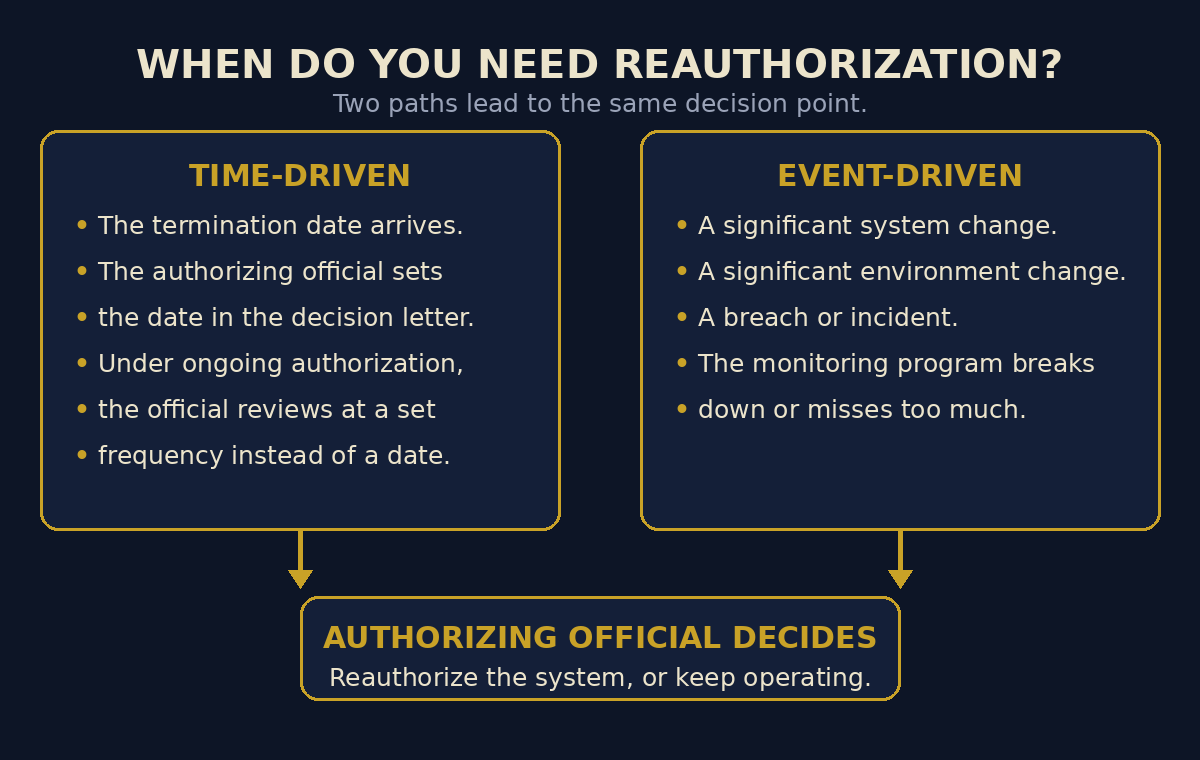
The authorizing official sets a termination date in your authorization decision letter. When that date arrives, authorization expires, and reauthorization is required (SP 800-37 Rev 2, Authorization Decision Information). Time-driven reauthorization happens when the specified date is reached (SP 800-37 Rev 2, Reauthorization).
NIST does not fix the length of the term. The official sets it, guided by federal and organizational policy (SP 800-37 Rev 2, Reauthorization).
If your system is under ongoing authorization, there is no termination date. Instead, the authorizing official reviews security and privacy information on your schedule. Your organization defines that frequency (SP 800-37 Rev 2, Ongoing Authorization). NIST SP 800-53 control CA-6 (Authorization) backs this up: update the authorization at an organization-defined frequency.
What changes force reauthorization early?
Event-driven reauthorization reacts to risk, not the calendar. A significant change is one likely to alter your security or privacy posture (SP 800-37 Rev 2, Reauthorization).
NIST gives concrete examples for systems. New or upgraded operating systems, middleware, or applications. Changed ports, protocols, or services. New hardware platforms, changed cryptographic modules, or changed controls. New ways of handling data, including PII (personally identifiable information).
Environment changes count too. Moving to a new facility or adding a new mission or business function. Credible new threat information, or new laws and policies. Your organization sets its own criteria for what counts as significant, based on mission, threat data, and impact level.
What events besides changes can trigger it?
Other triggers can start a review without any system change. New threat, vulnerability, or privacy risk information. A jump in findings from your monitoring program. A big shift in risk assessment results. Exceeding thresholds your organization already set.
A new authorizing official can also force the question. The new official reviews your package and decides whether the risk is still acceptable. If it is, they sign a new decision document. If it is not, they can order an authorization action. They cannot extend the original termination date (SP 800-37 Rev 2, Reauthorization).
Does anything change under ongoing authorization?
Most routine changes are handled through continuous monitoring, not reauthorization. That is the point of ongoing authorization (NIST SP 800-137).
But reauthorization can still happen. If risk rises above your tolerance, the authorizing official can order it. A breach or incident can trigger it. So can a monitoring program that fails or misses too much (SP 800-37 Rev 2, Reauthorization).
What should I do right now?
First, read your authorization decision letter and note the date or review frequency. Second, write down what your organization treats as a significant change. Third, run a security impact analysis before any major change ships. Use the results to decide if the authorizing official needs to weigh in.
If reauthorization is required, reuse what you can. NIST says to lean on monitoring and assessment data already collected. A reauthorization can be as narrow as updating plans, assessment reports, and the POA&M. POA&M (Plan of Action and Milestones) tracks every open weakness to a fix date. Or it can run as wide as the original authorization (SP 800-37 Rev 2, Reauthorization).
Keep the authorizing official informed early, before the date hits. Their answer about your status during review is the only one that counts.
Sources
- NIST SP 800-37 Rev 2, Appendix F: Reauthorization
- NIST SP 800-37 Rev 2, Appendix F: Authorization Decision Information
- NIST SP 800-37 Rev 2, Chapter 3: Ongoing Authorization
- NIST SP 800-137, Information Security Continuous Monitoring
Next step
Keep your authorization evidence current so reauthorization day is calm, not a scramble. See how PolicyCortex collects evidence from Azure automatically and re-checks controls after fixes.